
Her Sister’s Death by K.L. Murphy
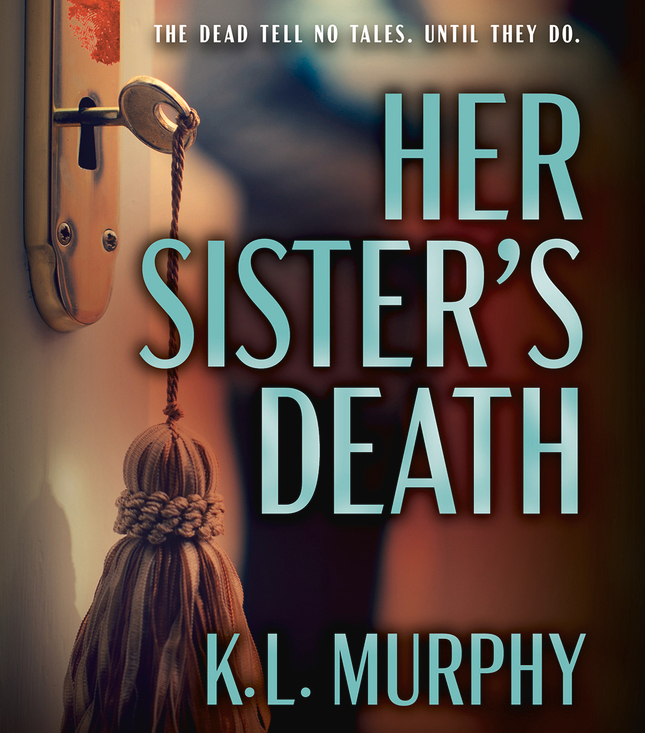
I was immediately hooked by the opening lines of K.L. Murphy’s latest novel, HER SISTER’S DEATH, where we meet the protagonist Val who, since childhood, has believed in her ability to research her way out of just about any problem. (Do I relate to this quirk personally? Maybe. Let me do a little digging and get back to you.) As an adult, Val channels her enthusiasm for research into her career as an investigative reporter. So it makes sense that when Val’s sister, Sylvia, dies in Baltimore’s posh and historic Franklin Hotel, and the police label it a suicide, Val wants to look into the matter.
As Sylvia’s closest confidante, Val finds it hard to believe that Sylvia would have killed herself and is determined to examine the final days of her sister’s life. Her search for information brings her into contact with Terry, a retired police officer who has his own connection to the Franklin Hotel. As Terry puts it, the hotel has a history of violence, but he is unwilling to tell Val all he knows. This history transports us to 1921 and the story of Brigit, a reluctant bride who honeymoons at the Franklin. Through multiple narrators (Val, Terry, and Brigit) and alternating timelines, Murphy tells the story of two sets of sisters and two troubled marriages–both of which culminate in acts of violence at the Franklin.
As Val and Terry team up to investigate Sylvia’s death, they gain access to footage of the hotel cameras. Because Sylvia stayed at the hotel for multiple days and with cameras all over the place, Val and Terry end up with hundreds of hours of footage to sort through. I liked how Murphy used this aspect of the story to build suspense. While the video might hold the answers to their questions, they don’t know where to look. Because they don’t have time to wade through it all, they bounce back and forth between suspects and then, armed with more information, return to specific spots in the video footage. The variety of these investigative techniques, the different voices of the narrators, and the alternating timelines made this book a huge page-turner. I would no sooner get drawn into Val’s story than we would move to Terry’s perspective, and then Brigit’s–then, of course, I’d have to keep reading because I needed to see what had happened to Val! Murphy kept the list of suspects rather short, yet she still kept me guessing until the very end, and although the Franklin was a public space with throngs of people passing through it, the tight cast of characters captured the atmosphere of a closed-room mystery.
Reader Takeaway: I enjoyed all aspects of this novel, especially Val’s determined personality and the ominous setting of the Franklin. Murphy is a skillful writer who excels at creating characters who feel authentically driven to solve the crime–in Val’s case because of her connection to the victim and in Terry’s, due to his mysterious connection to the Franklin.
Writer Takeaway: This is how you use setting as a character in a novel! Murphy brings the Franklin Hotel to life on the page and uses it to shape the story as much as any character could. (Think the The Overlook Hotel from The Shining but with Prohibition-era charm and history.)
2023 from CamCat Books
 Kate Michaelson